The Role of Sustainability and Value Creation in Urban Development
As cities face the challenges of rapid urbanization, there’s growing emphasis on the role of stakeholder networks and sustainable development. At the heart of this transformation is Sustainability and Value Creation (SVC)—a process led by various stakeholders aiming to achieve long-term impact through the Sustainable Development Goals (SDGs). Although SVCs and urban sustainability are linked, the specific contribution of SVC to achieving these goals remains obscure.
Sustainability generally encompasses social, economic, and environmental dimensions, ensuring balanced development. In urban contexts, a fourth institutional dimension becomes crucial, encompassing governance, policy, and stakeholder coordination. This development must meet the needs of the present without compromising the ability of future generations to meet their own needs. For this reason, the United Nations (2015) proposed 17 Sustainable Development Goals (SDGs), which serve as optimal units of analysis for assessing sustainable development at all levels, including the city level.
The literature highlights strong connections between Sustainability and Value Creation (SVC) and urban sustainability, while emphasizing the need for better integration of the environmental dimension. SVC shows notable impact in areas such as Decent Work and Economic Growth, Industry, Innovation and Infrastructure, Sustainable Cities and Communities, and Partnerships for the Goals—each reflecting the four key dimensions of sustainability. The following figure illustrates how SVC contributes to these goals. However, despite these insights, a clear knowledge gap remains regarding the specific ways SVC advances sustainable development.
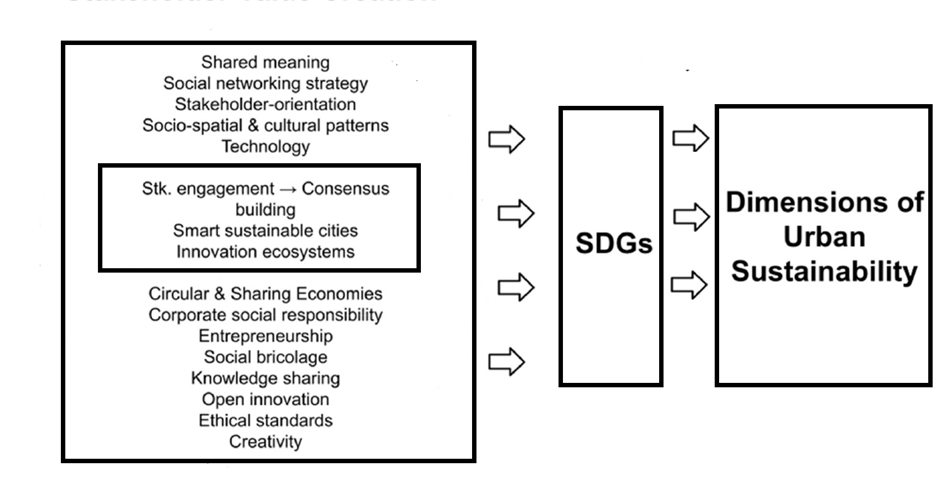
Figure. SVC Qualities and Interrelated Concepts for Achieving some SDGs.
Bridging Gaps: Advancing Research and Broadening Impact
Globally, Sustainability and Value Creation (SVC) has a global impact. It plays a key role by supporting consensus-building, smart sustainable cities, and innovation ecosystems. It also focuses on important areas like networking, cultural and spatial planning, technology, circular and sharing economies, social responsibility, entrepreneurship, knowledge sharing, open innovation, ethics, and creativity.
However, there is still not enough research on how SVC helps with some goals. These include Gender Equality, Life Below Water, and Life on Land. To fill this gap, researchers should consider the environment, gender balance, and even non-human actors when creating partnerships and projects.
At the same time, the goal of Sustainable Cities and Communities connects well with other goals. These include Good Health, Quality Education, and Gender Equality. But we must also be careful about possible trade-offs, especially in areas like Responsible Consumption and Production.
thanks, that was useful.
Good work. This makes our research a lot easier. Thanks for providing this information.