Introduction
The evolution of digital city concepts is advancing toward a state of ubiquitous integration. So,a ubiquitous city (often abbreviated as u-city) is a city where digital and communication technologies are embedded into the urban environment seamlessly, to empower citizens with services and infrastructure which are available anytime and anywhere through ubiquitous computing.
By 2030, more than 30% of urban infrastructure will run on AI. For example, not just smart traffic lights, but self-regulating energy grids, predictive policing, and even digital twin cities that simulate disasters before they happen. Therefore, sustaining our cities by giving them the tools to thrive is essential if we want to protect humanity and keep our living spaces resilient and future-ready.
The Smart City Journey
The transition from digital to ubiquitous cities shows how urban technology has evolved step by step.
- The first digital cities created the groundwork for e-governance, adding the first layer of connectivity.
- With the rise of IoT and sensors, cities became “smart,” adding visible infrastructure that linked the digital and physical worlds.
- In the 2010s, AI and big data pushed cities toward predictive and reactive systems—from generative AI designing walkable neighborhoods to autonomous drone deliveries reshaping logistics.
Now, in the era of ubiquity, technology fades into the background. Cities become fluid, context-aware spaces where computing is everywhere yet invisible. Digital twins simulate climate resilience (like Singapore’s virtual city model). Micro-mobility networks self-optimize. Brain-computer interfaces even hint at futuristic ways to interact with public services.
This shift marks a huge change: we’ve moved from digitizing services to ambient integration, where the city itself becomes an intuitive, adaptive interface for daily life.
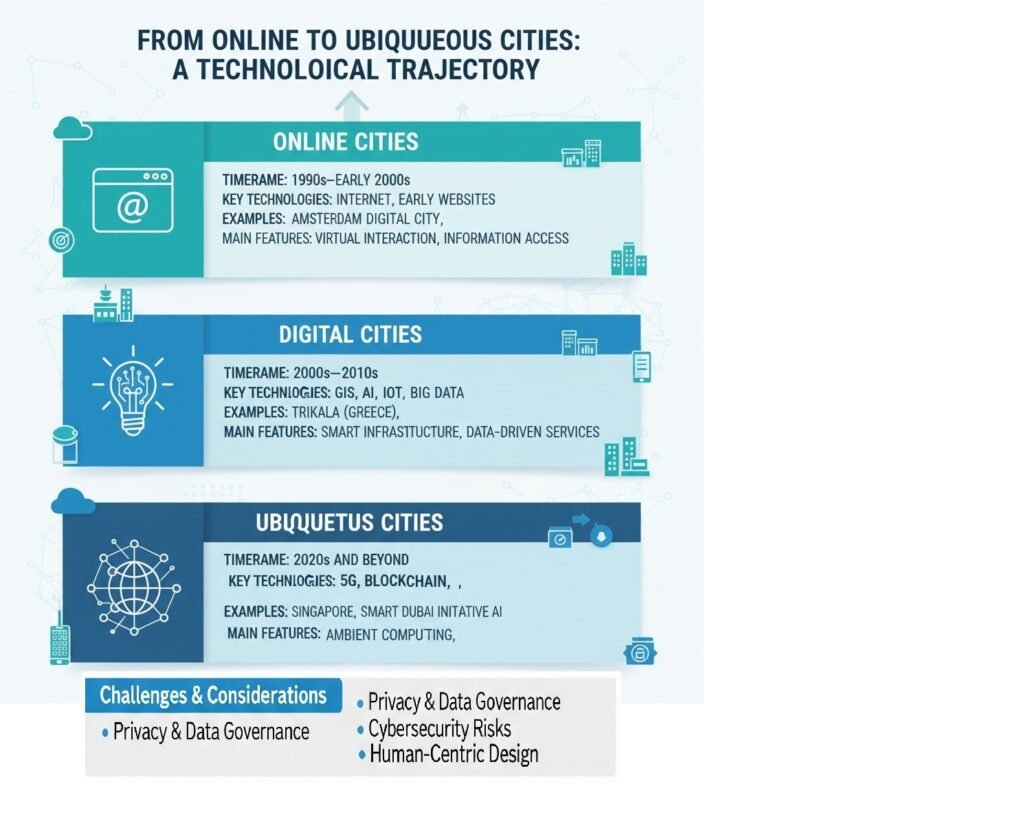
From Online cities, to Digital cities, to ubiquitous cities
Urban development has followed a remarkable technological trajectory; from the early days of online cities to the sophisticated, ambient intelligence of today’s ubiquitous cities. Each stage shows both technological growth and changing ways citizens interact with their urban spaces.
🕸️ Online Cities (1990s–early 2000s)
The earliest digital city initiatives—such as America Online (AOL) in the U.S., Amsterdam Digital City (DDS, 1994), and Helsinki Virtual Village; were early efforts to create virtual communities. Citizens could access basic public services and civic information from home. Though simple, these platforms proved digital tools could improve civic life and encourage participation.
💡 Digital Cities (2000s–2010s)
As internet infrastructure grew stronger, cities began adding sensors, GIS (Geographic Information Systems), and data platforms into their physical spaces.
Digital cities improved public services and made governance smarter and more inclusive. Even people with limited digital skills could access services more easily. Trikala, Greece, is a great example: its digital transformation shows how cities can move from basic web-based tools to more connected, responsive systems.
🌐 Ubiquitous Cities (2020s and beyond)
Today, we are entering the era of ubiquitous cities, where computing becomes invisible but ever-present. Moreover, technology is no longer stands out as separate infrastructure; it blends into daily life. From digital twins for climate resilience (like Singapore’s virtual city model) to self-optimizing transport networks and emerging brain-computer interfaces, the city itself becomes a living, intelligent system.
Benefits of Ubiquitous Smart Cities
Ubiquitous smart cities revolutionize urban living by combining AI, sensors, and ambient computing into environments that adapt and respond automatically.
Unlike earlier digital cities, modern examples like Seoul and Singapore show how urban infrastructure can self-regulate:
- Traffic flow adjusts in real time
- Energy grids balance themselves automatically
- Healthcare and safety systems respond proactively
However, this transformation raises tough questions:
- Who controls the massive amounts of data?
- Will vulnerable groups fall behind because of the digital divide?
- How do we protect these cities from cyber threats?
As we embrace smarter cities, we must keep them inclusive, ethical, and human-centered.
Conclusion
The integration of sensors, AI, and simulation tools is pushing cities toward a ubiquitous future; where services are available anytime, anywhere and urban systems protect both people and the planet.
Governments and tech leaders like Google, Siemens, and Cisco are investing heavily in smart city initiatives, measuring their impact on citizens’ lives and urban sustainability.
This article traced the path from basic digital cities to resilient, adaptive ecosystems that respond dynamically to change. Ubiquitous cities offer a holistic vision: cities that breathe with their citizens, blending ambient intelligence with human-centered design.
Ubiquitous cities are already emerging around us. The real question is:
- How do we keep them ethical and inclusive?
- What kind of urban future will we build together?
Would you live in a city that thinks—and maybe even feels—with you?
This information is very useful. Thanks for this useful content.